Artificial Intelligence (AI) has become a buzzword shaping industries, cultures, and imaginations. However, while machines learn, adapt, and sometimes outperform humans in specific domains, the question remains: What truly distinguishes AI from human intelligence? This article dives deep into their fundamental differences, strengths, and weaknesses—and explores what this comparison means for our future.
Defining Intelligence: Human vs. Artificial
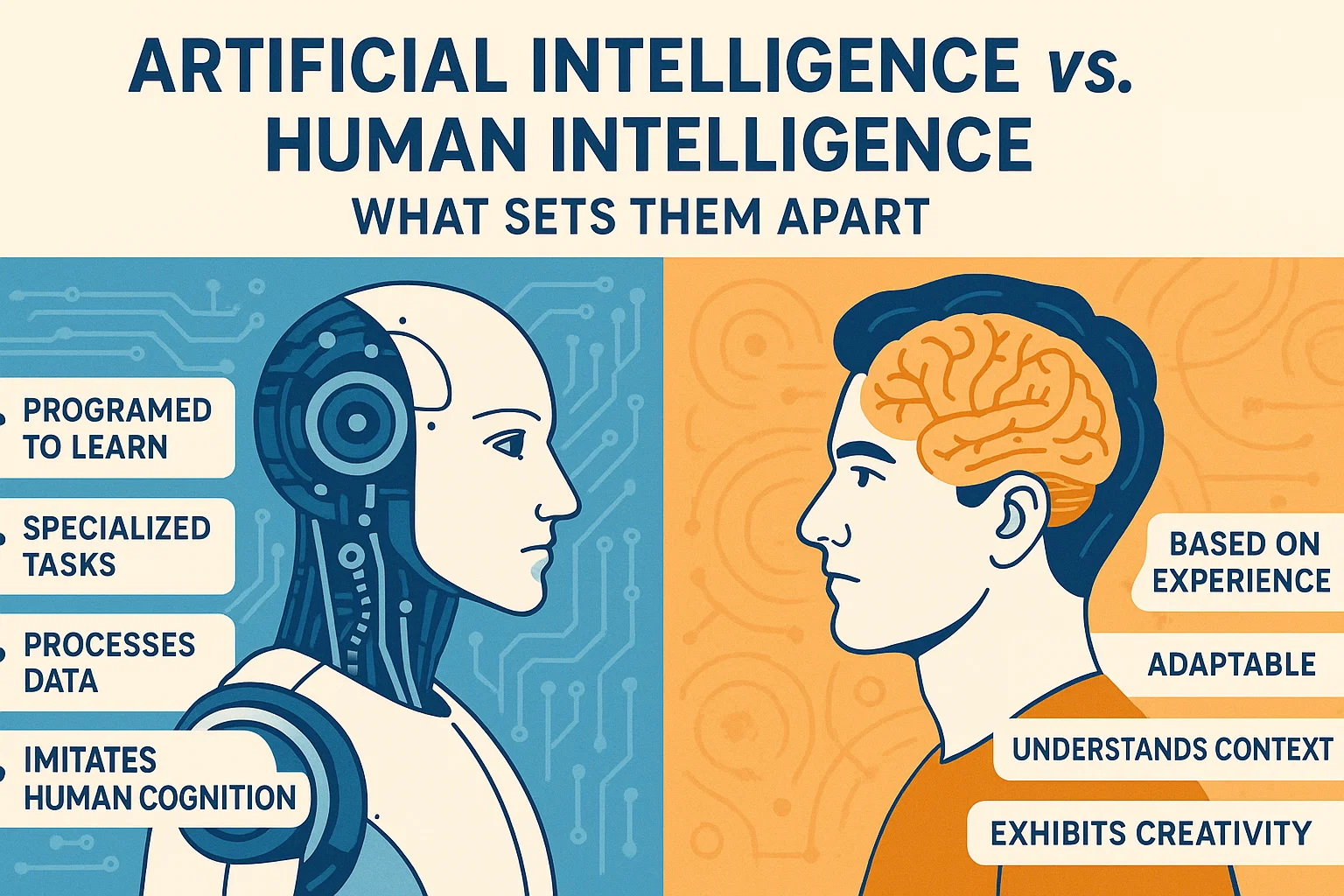
Human intelligence is biological, adaptive, and holistic, shaped by evolution and experience. It encompasses reasoning, learning, creativity, and emotional depth. AI, on the other hand, is engineered intelligence, built from algorithms and data structures that mimic particular human abilities but lack consciousness or self-awareness.
Human intelligence is the ability to learn from experience, adapt to new situations, understand complex ideas, and use knowledge to manipulate one’s environment.
AI, by contrast, is defined by the capacity of machines to perform tasks requiring human-like cognition, such as problem-solving, pattern recognition, or language processing.
Learning and Adaptation
Humans learn through experience, social interaction, and abstract reasoning. A child can recognize a cat after seeing just one or two examples. AI systems, however, often require massive datasets to generalize patterns. Machine learning models excel at statistical correlations but struggle with common-sense reasoning.
For instance, GPT-based models can generate essays or code by learning from millions of examples, but they don’t truly “understand” the content.
Creativity and Innovation
Creativity is where humans shine. Writers, artists, and inventors produce novel ideas that break rules and redefine categories. AI can generate “creative” outputs—paintings, music, or poetry—but it does so by recombining existing data rather than producing genuinely original insights. AI creates combinations of the old. Human creativity transcends data—it imagines the impossible.
Emotional Intelligence and Empathy
Humans understand emotions not just as data points, but as lived experiences. Emotional intelligence enables empathy, relationship-building, and social harmony. AI, while capable of sentiment analysis, lacks genuine empathy. A chatbot may “recognize” sadness in text but cannot feel it.
This distinction becomes critical in fields like healthcare, counseling, or leadership—areas where empathy is indispensable.
Speed, Memory, and Processing Power
AI surpasses humans in raw processing power. A supercomputer can perform calculations in seconds that would take humans lifetimes. Memory storage in machines is nearly limitless, while humans forget, distort, or selectively recall.
Yet, forgetting can be beneficial: it allows humans to prioritize, contextualize, and focus on what matters. Machines still lack this nuanced memory filtering.
Contextual Understanding
Human intelligence thrives on context. We can interpret a joke, detect sarcasm, or navigate ambiguity. AI struggles here. Even advanced models may misinterpret context when data is incomplete or phrasing is subtle.
Example: When someone says, “Great, just what I needed!” after spilling coffee, humans recognize sarcasm instantly. AI, however, may interpret it literally as positive feedback.
Ethical and Moral Reasoning
Humans possess moral frameworks informed by culture, philosophy, and personal experience. AI, in contrast, operates within programmed constraints. While machine ethics is an emerging field, algorithms cannot independently develop moral reasoning.
For example, autonomous vehicles face the “trolley problem”: should the car prioritize passengers or pedestrians? This ethical decision is pre-programmed by humans, not reasoned by the machine.
Collaboration: Humans and AI Together
Instead of viewing AI as a competitor, the most powerful approach is collaboration. AI handles tasks requiring speed, precision, and scalability, while humans contribute creativity, empathy, and ethical judgment. This partnership is already visible in:
- Healthcare: AI supports doctors in diagnostics.
- Finance: Algorithms detect fraud while humans manage strategy.
- Art: Artists use AI tools as co-creators.
The Future of Intelligence
The boundary between AI and human intelligence will continue to blur. Hybrid models—where human intuition guides machine precision—are likely to dominate. However, existential debates remain: Will AI ever achieve consciousness? Should it?
Artificial intelligence will not replace humans. But humans who use AI will replace humans who don’t.
Conclusion and Call-to-Action
AI and human intelligence are not rivals—they are complements. Machines excel at scale and speed, while humans lead in creativity, empathy, and ethics. The real future lies in collaborative intelligence, where each entity enhances the strengths of the other.
How do you envision the relationship between AI and human intelligence evolving? Share your thoughts in the comments or join the discussion on social media.
FAQs
Q1: Can AI ever become conscious?
Currently, AI lacks consciousness and self-awareness. It processes data but does not “experience” reality.
Q2: Which jobs are most at risk from AI?
Routine, repetitive, and data-driven jobs are most vulnerable. Creative, empathetic, and strategic roles remain largely human-driven.
Q3: How do humans and AI complement each other?
AI brings scale and efficiency, while humans provide intuition, ethics, and empathy.