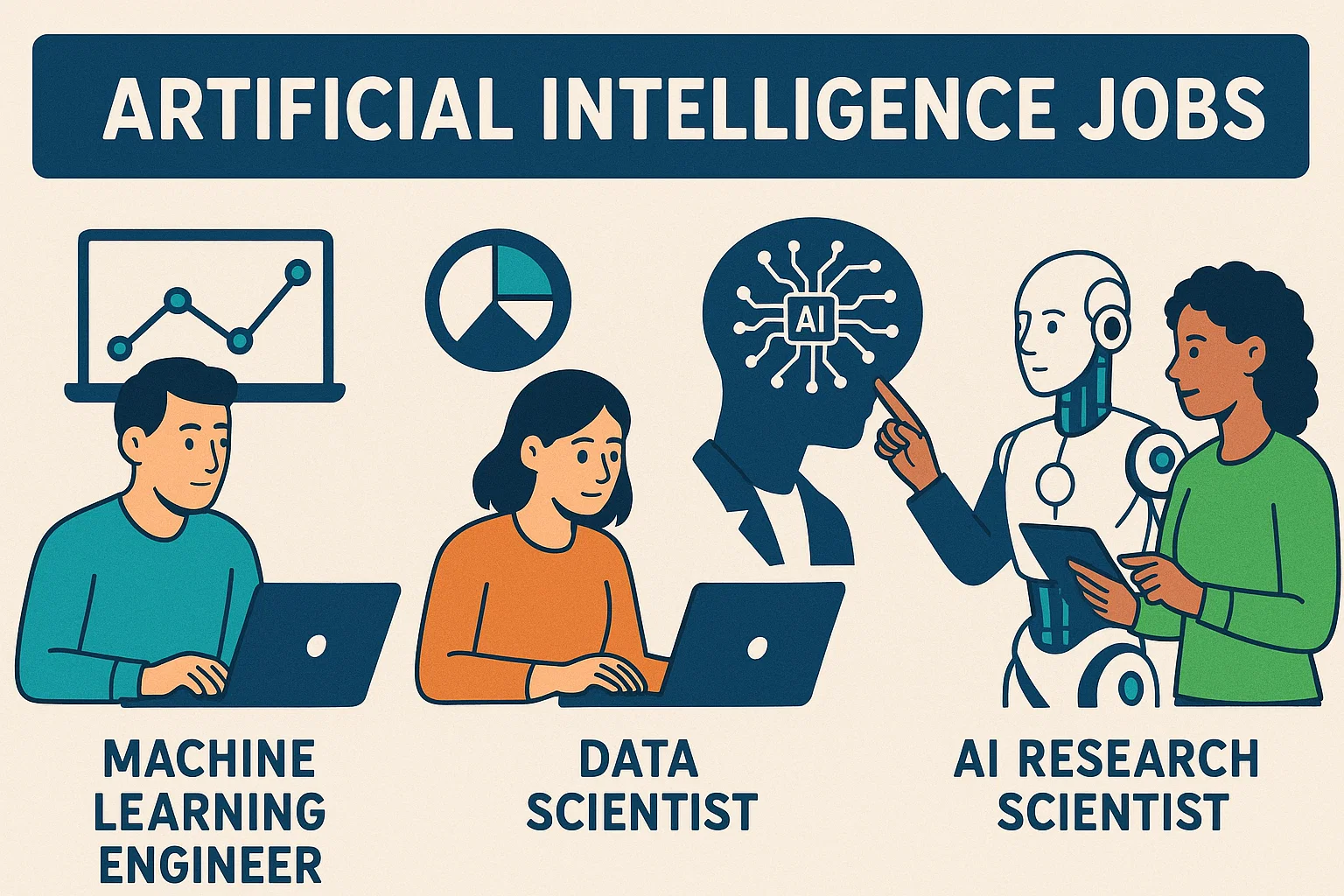
Artificial Intelligence (AI) is reshaping the global workforce at a rapid pace. While the media often highlights the risk of job losses, the reality is more nuanced: AI will not only replace specific tasks but also generate entirely new career opportunities. AI and automation are expected to create millions of new jobs.
Result: In this article, you’ll discover the top 10 jobs AI will create in the next decade and how you can prepare for them.
Exclusion: We will not focus on jobs at risk of automation, but exclusively on new, emerging opportunities.
The Rise of AI-Driven Careers
AI adoption is accelerating across industries. Young professionals should focus not only on surviving automation but on thriving within the AI-driven economy.
Top 10 Jobs AI Will Create in the Next Decade
AI Trainer & Prompt Engineer
- Definition: Specialists who teach AI models how to respond effectively by curating datasets and crafting prompts.
- Why it matters: AI tools like ChatGPT depend on human input to refine their accuracy.
- Key skills: Linguistics, programming basics, domain expertise.
- Growth outlook: High demand as companies race to integrate generative AI.
Data & Algorithm Ethicist
- Definition: Experts ensuring AI algorithms are fair, unbiased, and transparent.
- Why it matters: Preventing bias in AI is crucial for public trust.
- Key skills: Ethics, law, data science.
- Growth outlook: Increasing regulatory focus will drive demand.
AI-Assisted Healthcare Specialist
- Definition: Professionals using AI-powered diagnostic tools to improve patient care.
- Why it matters: AI can detect diseases faster and more accurately than humans.
- Key skills: Medical training, data interpretation, empathy.
- Growth Outlook: Healthcare remains a top sector for AI investment.
Automation Workflow Designer
- Definition: Experts who design and optimize workflows that integrate humans and AI.
- Why it matters: Companies need seamless collaboration between people and machines.
- Key skills: Process management, systems design, communication.
- Growth outlook: Broad applications across industries.
Human-AI Interaction Designer
- Definition: Professionals designing intuitive interfaces for AI tools.
- Why it matters: Usability is key to adoption.
- Key skills: UX/UI design, psychology, and computer science.
- Growth outlook: Rising demand as AI integrates into daily life.
AI-Powered Cybersecurity Analyst
- Definition: Specialists leveraging AI to detect and counter cyber threats.
- Why it matters: Cybersecurity threats are evolving rapidly.
- Key skills: Cybersecurity, AI, risk analysis.
- Growth outlook: Strong demand due to increasing digital risks.
Digital Twin Architect
- Definition: Engineers creating digital replicas of physical systems for testing and optimization.
- Why it matters: Helps industries simulate real-world scenarios.
- Key skills: Engineering, simulation software, AI.
- Growth outlook: Strong role in manufacturing, aerospace, and urban planning.
AI-Enhanced Teacher / Learning Designer
- Definition: Educators who integrate AI tools to personalize student learning.
- Why it matters: AI enables adaptive learning tailored to individual needs.
- Key skills: Teaching, edtech, curriculum design.
- Growth outlook: High as digital learning expands globally.
Smart City Planner
- Definition: Specialists utilize AI to design sustainable and efficient urban spaces.
- Why it matters: Cities must adapt to growing populations and the impacts of climate change.
- Key skills: Urban planning, sustainability, and AI modeling.
- Growth outlook: Governments are investing heavily in innovative city initiatives.
AI Sustainability Analyst
- Definition: Experts measuring and minimizing AI’s environmental impact.
- Why it matters: AI requires significant energy; sustainability is key.
- Key skills: Environmental science, AI, data analysis.
- Growth outlook: Growing importance as climate concerns rise.
Skills Needed to Thrive in AI Jobs
- Analytical thinking & problem-solving
- AI literacy (basic coding, machine learning principles)
- Soft skills (adaptability, empathy, creativity)
- Interdisciplinary knowledge (law, ethics, business)
How Young Professionals Can Prepare Today
- Education paths: Degrees in AI, data science, or relevant fields.
- Online learning: Platforms such as Coursera, Udacity, and edX.
- Certifications: Google AI, Microsoft Azure AI, AWS Machine Learning.
- Networking: Join AI communities, attend tech conferences, engage on LinkedIn.
Challenges & Ethical Questions
- Bias in AI models: How can fairness be guaranteed?
- Data privacy: Protecting sensitive information.
- Accessibility: Ensuring all workers benefit from AI.
Conclusion
Artificial Intelligence is more than a disruptive force – it is a catalyst for new opportunities. For young professionals, the next decade will offer exciting, AI-driven career paths that didn’t exist before. The time to start building the right skills is now.
What do you think? Which AI-driven job excites you the most? Share your thoughts in the comments!
FAQs
Will AI create more jobs than it destroys?
Yes. While some jobs will be automated, new categories of work will emerge, especially in AI development, ethics, and human-AI collaboration (World Economic Forum, 2020).
Which industries will benefit most from AI job creation?
Healthcare, education, cybersecurity, and urban planning are among the fastest-growing.
Do I need a tech background to work in AI-related jobs?
Not always. Many roles (e.g., ethics, education, design) require interdisciplinary skills rather than coding expertise.