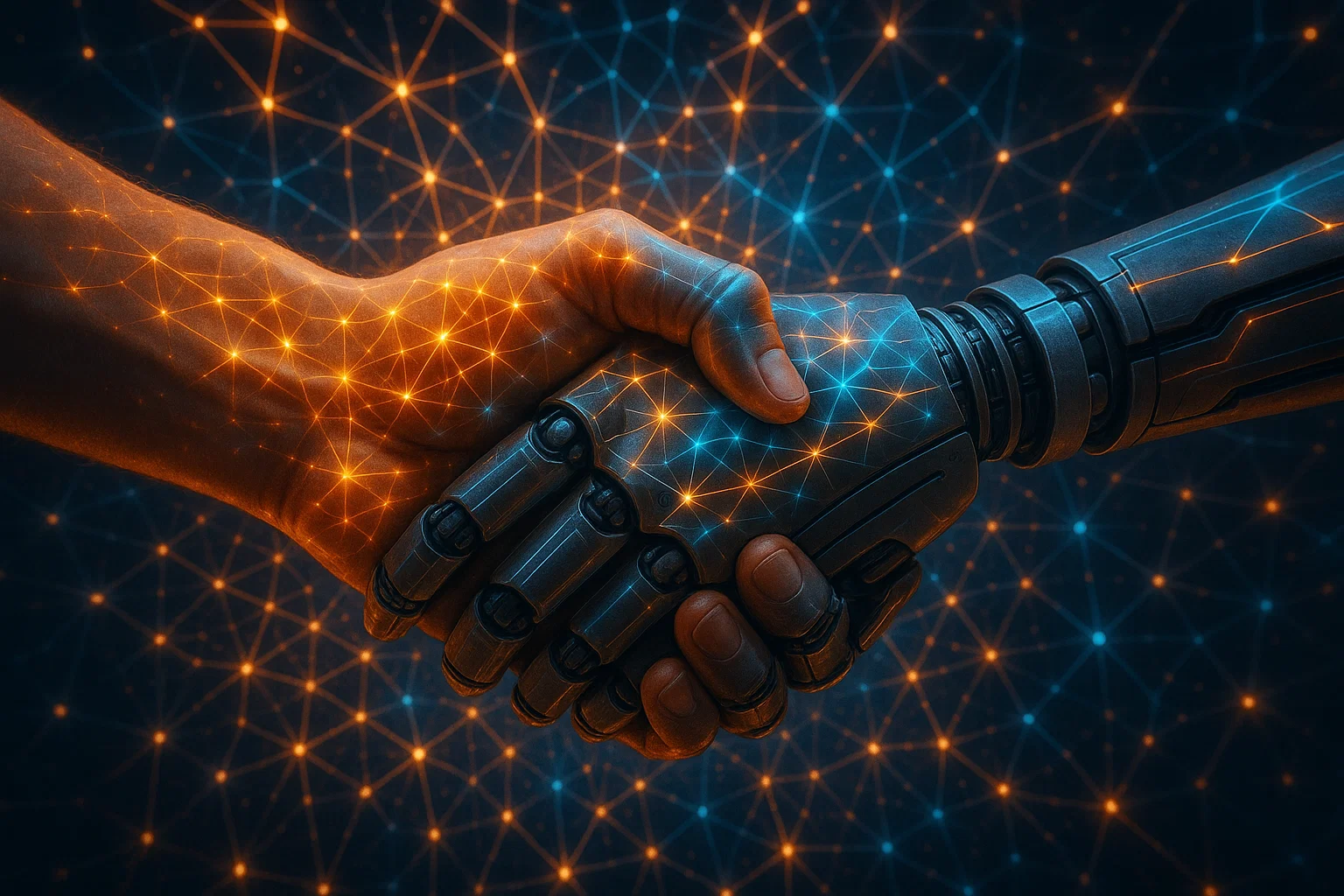
We are entering what might be the most transformative era in human history: the Symbiosis Era, where humans and artificial intelligence evolve side by side. This is not the age of replacement, as dystopian headlines often suggest, but one of amplification—where AI expands the boundaries of what individuals can imagine, create, and achieve.
This post explores how AI can scale human potential through collaboration, learning, and creativity. It will not cover technical aspects of AI development or corporate automation strategies, but rather focus on personal growth, adaptability, and the deep partnership forming between human intuition and machine intelligence.
The Shift from Automation to Augmentation
For decades, the narrative around AI has been about automation—machines doing what humans can’t or don’t want to do. Yet, the more profound shift is augmentation: machines helping humans do what they do best, better.
AI’s greatest strength is not its speed or memory, but its ability to expand the range of human possibility. A writer can brainstorm faster with AI; a scientist can model ideas once trapped in the realm of speculation; an artist can explore infinite variations of form and color.
Learning in the Age of Intelligence
In the symbiosis era, learning is no longer a linear process—it’s a dynamic exchange between human curiosity and algorithmic insight.
AI tutors, adaptive learning platforms, and personalized feedback loops are helping individuals learn at their own pace while revealing new cognitive patterns. Instead of memorizing information, people can now focus on understanding, synthesis, and application.
Imagine a language learner conversing daily with an AI partner that adjusts tone, grammar, and complexity to match progress. The result isn’t just faster learning—it’s a deeper empathy for communication itself.
Education in this new era is less about accumulation and more about co-creation between human intent and digital scaffolding.
Creativity and the Collaborative Imagination
Creativity has long been considered a uniquely human domain, yet AI has become a partner in this sacred space. Whether through generating musical ideas, designing products, or imagining virtual worlds, AI tools are extending the boundaries of imagination.
But creativity thrives not when humans outsource their work to machines, but when they collaborate with them. AI provides the canvas of possibility, and humans bring the emotional resonance, context, and meaning.
A designer using AI to generate visual concepts isn’t losing their voice—they’re amplifying it, tapping into a feedback loop of inspiration and refinement. The creative process becomes less about control and more about conversation.
The Human Advantage: Emotional Intelligence and Ethics
While AI may analyze, predict, and simulate, humans remain unmatched in empathy, intuition, and moral judgment. These are not inefficiencies to be optimized away—they are the anchors of wisdom in a data-driven world.
AI can inform decisions, but only humans can interpret meaning, assign values, and navigate ethical complexity. The challenge of our age is not whether AI will surpass us, but whether we can cultivate the emotional depth to wield it responsibly.
The symbiosis era will reward those who blend technical fluency with emotional literacy—a combination that defines true intelligence in the age of machines.
Building a Symbiotic Mindset
To grow alongside AI, we must shift from fear to curiosity, from competition to co-creation. This means adopting a symbiotic mindset—a recognition that the boundary between human and machine is not a wall but a bridge.
Practical steps include:
- Embracing AI as a creative partner, not just a productivity tool.
- Using AI feedback to enhance self-awareness and skill mastery.
- Engaging in ethical reflection about how our digital tools shape behavior and society.
Those who cultivate adaptability and reflective intelligence will find themselves thriving in a world where learning never ends.
Conclusion: The Future Is Coevolution
The story of humanity has always been one of collaboration—with nature, with tools, and now, with intelligence itself. The Symbiosis Era is not about humans becoming machines or machines becoming human. It’s about both evolving into something greater together.
To scale human potential with AI is to see intelligence as a shared ecosystem—one where every prompt, idea, and question adds to the collective expansion of mind and meaning.
Begin today. Use AI not to replace your creativity but to challenge it. Experiment, question, collaborate. The future of growth is not artificial—it’s deeply, beautifully human.
FAQs
Q1: Will AI make human creativity obsolete?
No. AI enhances creativity by handling routine work and generating novel ideas, leaving humans free to focus on meaning, emotion, and originality.
Q2: How can individuals use AI for personal growth?
By treating AI as a reflective partner for learning, journaling, brainstorming, and feedback—turning technology into a mirror for self-improvement.
Q3: Is there a risk of overdependence on AI?
Yes. The key is balance—maintaining self-awareness and critical thinking while using AI as a tool, not a crutch.