Crypto markets often appear chaotic—prices pump and dump seemingly at random, retail traders chase breakouts, and liquidations happen in minutes. Yet, beneath this surface-level volatility lies a structured dance of liquidity, manipulation, and intent. This is where Smart Money Concepts (SMC) come in.
Smart Money Concepts are trading principles that aim to reveal how large institutional players—hedge funds, market makers, and whales—actually move the market. Unlike traditional indicators that react to price, SMC focuses on understanding why price moves in certain ways.
In this guide, we’ll decode the core ideas behind Smart Money Concepts, show you how to recognize institutional footprints, and teach you how to think like a professional trader in the wild world of crypto.
The Origin of Smart Money Concepts
The idea of “smart money” dates back to traditional finance, referring to capital controlled by experienced, well-informed investors. In the crypto space, this concept evolved through communities of traders who studied institutional order flow—how big players accumulate and distribute assets.
Smart Money Concepts became popular thanks to educators who translated these institutional behaviors into identifiable patterns: liquidity grabs, order blocks, and fair value gaps. These tools help traders see beyond retail traps and understand how markets are engineered to generate liquidity.
Retail vs. Smart Money
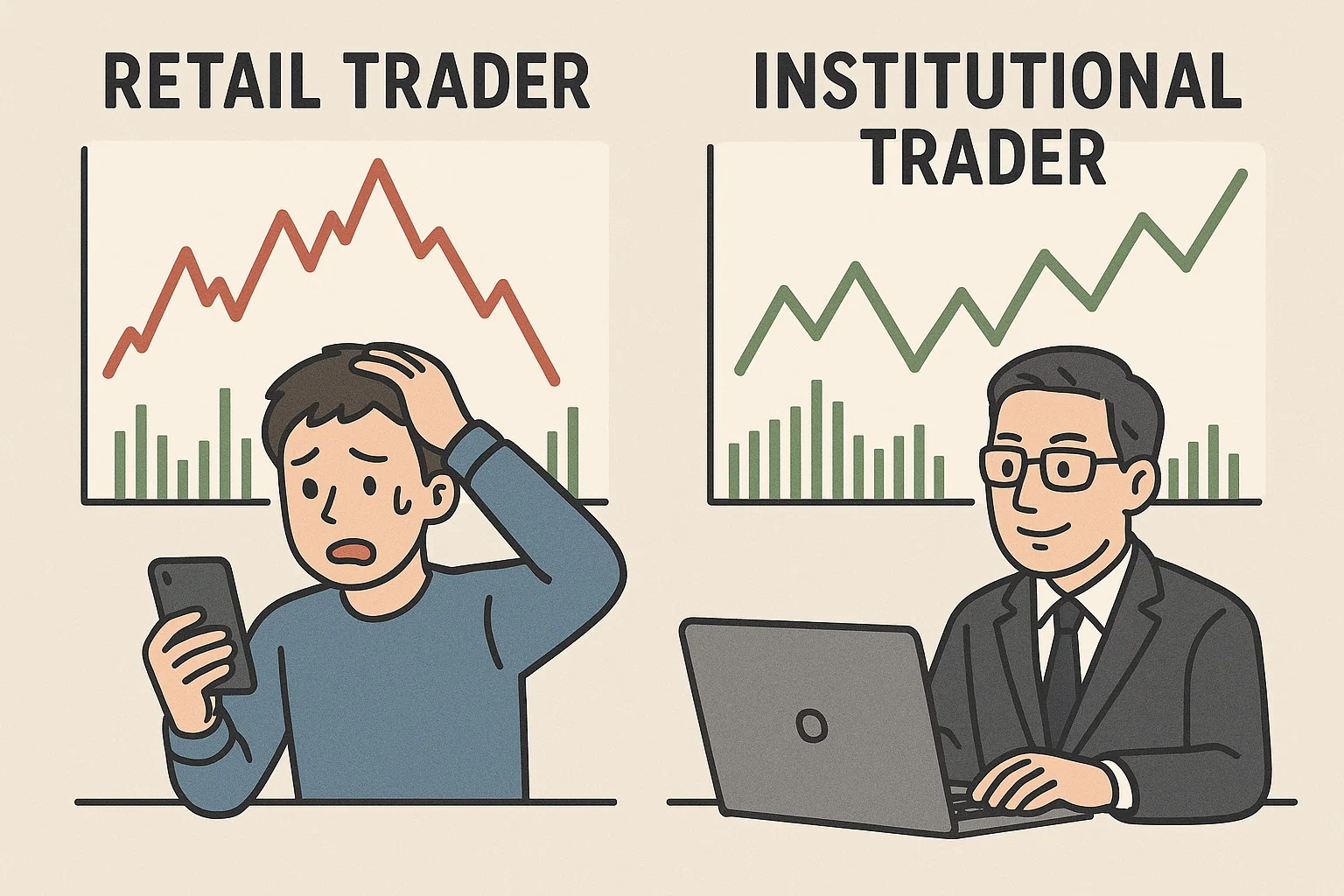
Most retail traders react to price. They see green candles and buy, red candles and sell. Institutions, however, create these moves intentionally.
Retail traders tend to:
- Enter trades based on indicators (RSI, MACD, etc.)
- Place stop losses at predictable points
- Buy breakouts that often reverse
Smart Money, on the other hand:
- Accumulates positions slowly while the crowd is fearful
- Triggers liquidity events to fill orders
- Sells into euphoria and buys into panic
Understanding this psychological difference is the foundation of SMC. Institutions need liquidity to enter and exit massive positions. Retail traders provide that liquidity by placing stop losses and chasing moves.
Key Components of Smart Money Concepts
Market Structure
Market structure is the backbone of SMC. It describes how price moves in trends and ranges. The two main types are:
- Bullish Market Structure: Higher highs and higher lows.
- Bearish Market Structure: Lower highs and lower lows.
When market structure shifts—say, a lower low after a series of higher highs—it can signal that smart money is reversing direction.
Liquidity
Liquidity refers to pools of orders sitting in the market—often at obvious levels like previous highs and lows. Institutions hunt these zones to trigger stop losses and fill their positions.
Example: If Bitcoin hovers just below a previous swing high, there’s likely a cluster of stop-loss orders from short traders. Smart money pushes price above that high to grab liquidity, then reverses direction.
Order Blocks
Order blocks are areas where institutions have placed significant buy or sell orders. They often appear as the last bullish or bearish candle before a major move.
For instance, before Bitcoin skyrockets, there might be a final bearish candle. That candle’s range marks the bullish order block, where institutional buying occurred.
Fair Value Gaps (FVGs)
A fair value gap is an inefficiency in price movement—a small gap left when price moves too fast. Smart money often returns to these areas later to rebalance price.
Identifying FVGs can help traders predict potential retracement zones or areas where price is likely to react.
How Institutions Move the Market
Institutional traders don’t chase candles—they engineer them. The market operates in a cycle of accumulation, manipulation, and distribution:
- Accumulation: Institutions quietly buy crypto when retail sentiment is negative.
- Manipulation: Price spikes to trigger stop losses and collect liquidity.
- Distribution: Institutions sell into retail demand at inflated prices.
This process repeats endlessly. Recognizing it can help you avoid emotional trades and align with the true direction of the market.
Example
Imagine Ethereum trading in a range between $2,900 and $3,100. Retail traders are shorting the top and longing the bottom. Institutions, meanwhile, wait.
When price breaks below $2,900, stop losses from long traders are hit—creating liquidity. Smart money steps in, buys those liquidated positions, and pushes price up. The sudden rally above $3,100 triggers short stops, providing more liquidity for distribution.
This pattern—called a liquidity grab—is one of the clearest signs of smart money activity.
Common Mistakes Beginners Make
- Overcomplicating charts: Too many indicators blur the big picture.
- Ignoring market structure: Without it, you can’t identify institutional intent.
- Chasing moves: By the time you notice, smart money has already exited.
- Mislabeling order blocks: Not every candle cluster is an institutional zone.
- Forgetting liquidity: Stop-loss clusters drive much of price movement.
Patience, clarity, and discipline are far more important than prediction.
Step-by-Step: Applying Smart Money Concepts to Crypto
- Identify market structure. Determine if the trend is bullish, bearish, or ranging.
- Mark liquidity zones. Look for equal highs/lows, swing points, and obvious stop zones.
- Spot order blocks. Find the last opposing candle before a strong move.
- Locate fair value gaps. These often attract price back later.
- Wait for confirmation. Look for a market structure break before entering.
- Use smart risk management. Even institutional setups can fail—manage your stop loss.
When used correctly, these steps can transform random trading into a structured decision-making process.
Smart Money vs. Traditional Technical Analysis
Traditional analysis relies on lagging indicators, while Smart Money Concepts focus on price behavior and intent. Instead of reacting to signals, SMC traders anticipate moves by understanding liquidity and manipulation.
The key difference: indicators show what price is doing; Smart Money Concepts explain why.
Tools and Resources to Learn More
- TradingView: For marking structure, order blocks, and liquidity zones.
- High-volume exchanges: Observe price behavior on Binance, Bybit, or Coinbase.
- Screen recorders or replay mode: Analyze historical smart money moves.
Consistency in observation builds intuition—study price like a detective, not a gambler.
Conclusion
Smart Money Concepts invite traders to stop reacting and start understanding. Crypto markets may seem chaotic, but beneath the surface, they’re governed by logic, psychology, and liquidity. By learning how institutions move price, you can align your trades with the flow of real capital rather than getting caught in retail traps.
The next time you see a sudden wick or fake breakout, ask yourself—not what happened, but why. That’s the essence of trading like smart money.
Ready to take your trading beyond indicators? Start applying Smart Money Concepts to your crypto charts today. Begin by marking liquidity zones and watching how price reacts around them—you’ll start to see the market through new eyes.
FAQs
Q1: Is Smart Money Concept trading profitable for beginners?
It can be, but it requires patience and practice. The goal is to learn how institutions think, not to predict every move.
Q2: Can SMC work on all crypto pairs?
Yes, but liquidity levels vary. Major pairs like BTC/USDT or ETH/USDT show cleaner structures.
Q3: Do I need indicators for Smart Money trading?
Not necessarily. Price action and structure are more important.
Q4: What timeframe works best?
The 1-hour and 4-hour charts are ideal for spotting institutional behavior, but daily charts show the broader context.